Rules
Celebrity Baby Name Trademark: USPTO Rules vs Reality
Celebrity baby name trademark filings mostly fail at the USPTO because a name is not a source identifier. Here is what the agency actually registers.
What to take away
- The USPTO registers trademarks that identify the source of goods or services, not names as such, so a bare baby name almost always fails.
- A celebrity can sometimes register a stylized logo, a signature, or a name tied to a specific product line, which is a different legal animal.
- Personal names can be registered when they acquire distinctiveness, but that usually takes years of commercial use and evidence.
- Rejection is the default outcome, and the cost of a failed application is the filing fee plus attorney time, not a refund.
- Treat "trademark a baby name" as a branding question, not a naming-rights question.
The core rule the USPTO applies
The agency's own explanation is blunt: a trademark identifies the source of goods or services and distinguishes them from competitors. A name alone does not do that work. When a fan files for a newborn's name in Class 25 for clothing, the examiner sees a word that describes a person, not a brand.
The application is refused under Section 2(e)(1) for descriptiveness or under the broader principle that a personal name is not inherently distinctive. You can read the framework at the USPTO trademark basics page.
Two other parts of the same section of the Trademark Act, 15 U.S.C. § 1052, matter more for a child's name. Section 2(c) bars a mark that consists of or comprises a name, portrait, or signature identifying a particular living individual except by his written consent. Section 2(e)(4) bars a mark that is primarily merely a surname. The USPTO's guidance on living persons spells out the practical step: an application that uses another living person's name cannot be submitted in Trademark Center until that person's written consent has been uploaded, and the consent document must include a statement consenting to registration and the signature of the living person.
This is why the phrase "celebrity baby name trademark" produces so much confusion. People search it expecting a registration database full of infant names. What they find instead is a small set of stylized marks owned by parents who already run businesses.
Where celebrity filings actually succeed
A celebrity parent rarely registers the child's name as a plain word. The successful filings tend to share one trait: the name is attached to something sold.
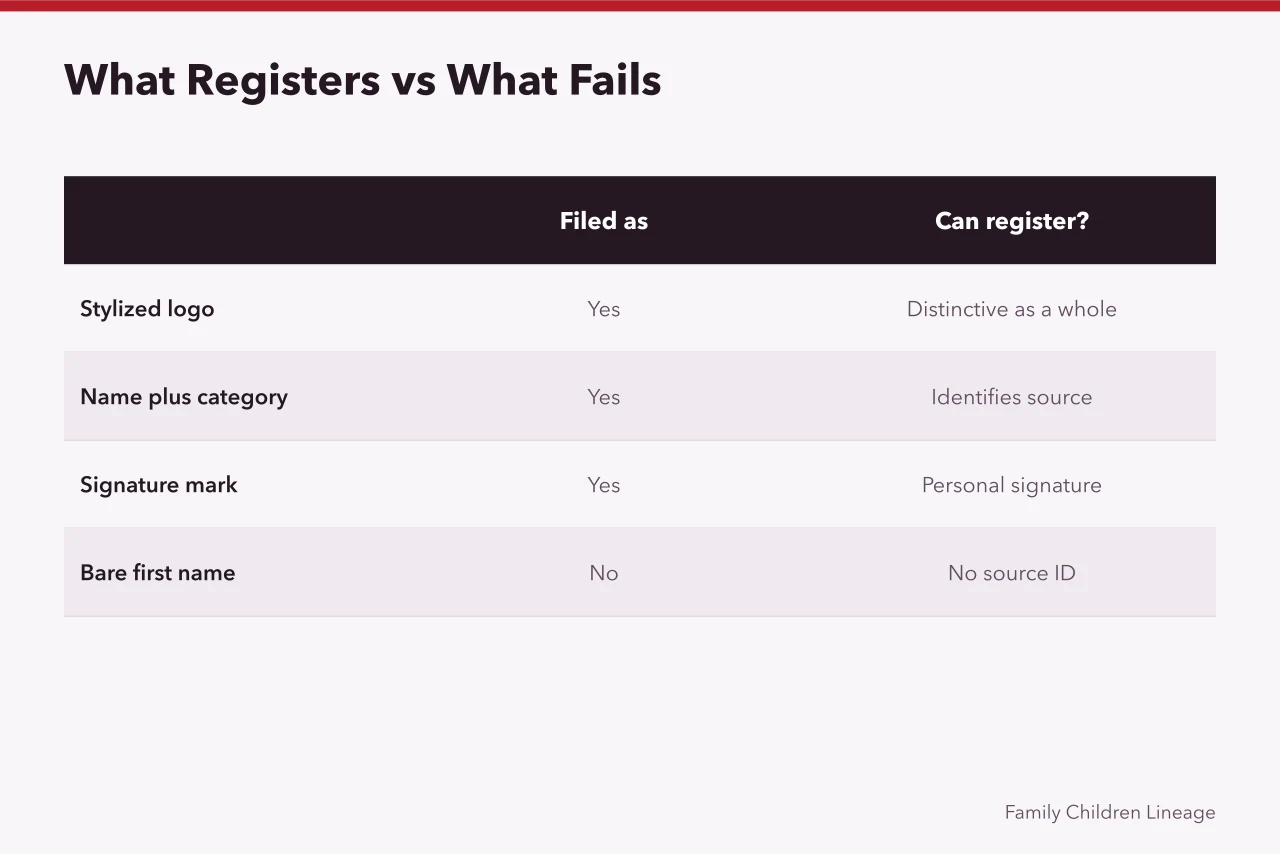
| What was filed | Why it can register | Typical class |
|---|---|---|
| Stylized logo with the child's name | The design is distinctive as a whole | 25, clothing |
| Name plus a product category | Identifies source of a specific good | 03, cosmetics |
| Signature or handwriting mark | Personal signature has distinctiveness | 16, printed matter |
| Bare first name, no goods | No source identification | none, refused |
A stylized logo can clear the bar because the examiner looks at the whole mark, not the words inside it. The same name in plain block letters usually cannot. Wikipedia's overview of trademarks notes the acquired-distinctiveness route, which is the path a determined parent would have to walk.
The distinctiveness hurdle in practice
Acquired distinctiveness means the public associates the name with one commercial source. That is a high bar for a child who has not sold anything. An applicant must show years of use, advertising spend, and consumer recognition.
A name becomes a trademark when buyers use it to tell one seller from another, not when a parent likes how it sounds.
For a newborn, there is no such history. The application fails on the record, and the examiner does not weigh fame in the abstract.
What a failed application costs
Fees are real money even when the outcome is predictable. A base application runs a few hundred dollars per class, and attorney preparation commonly adds several hundred more. Ranges below are illustrative and vary by class count and counsel.
Item / Illustrative range
- USPTO filing fee, one class
- $250 to $350
- Attorney preparation
- $500 to $1,500
- Office action response
- $400 to $1,200
- Total for a refused mark
- $1,150 to $3,050
The agency's application process page lays out the filing steps and the examination sequence. Nothing in that sequence returns the fee when the mark is refused.
How to compare the two realities
Side by side, the popular idea and the legal rule diverge at almost every point.
| Popular idea | Legal rule |
|---|---|
| A famous parent can reserve the child's name | A name registers only as a mark for named goods or services |
| Filing early locks the name up | An intent-to-use filing still needs a bona fide plan to sell |
| Fame makes the mark strong | Examiners judge the mark against the goods, not the applicant |
| Anyone can file a celebrity child's name | Section 2(c) requires the living person's written consent |
| A refusal is a loss for the family | A refusal leaves a common word free for everyone |
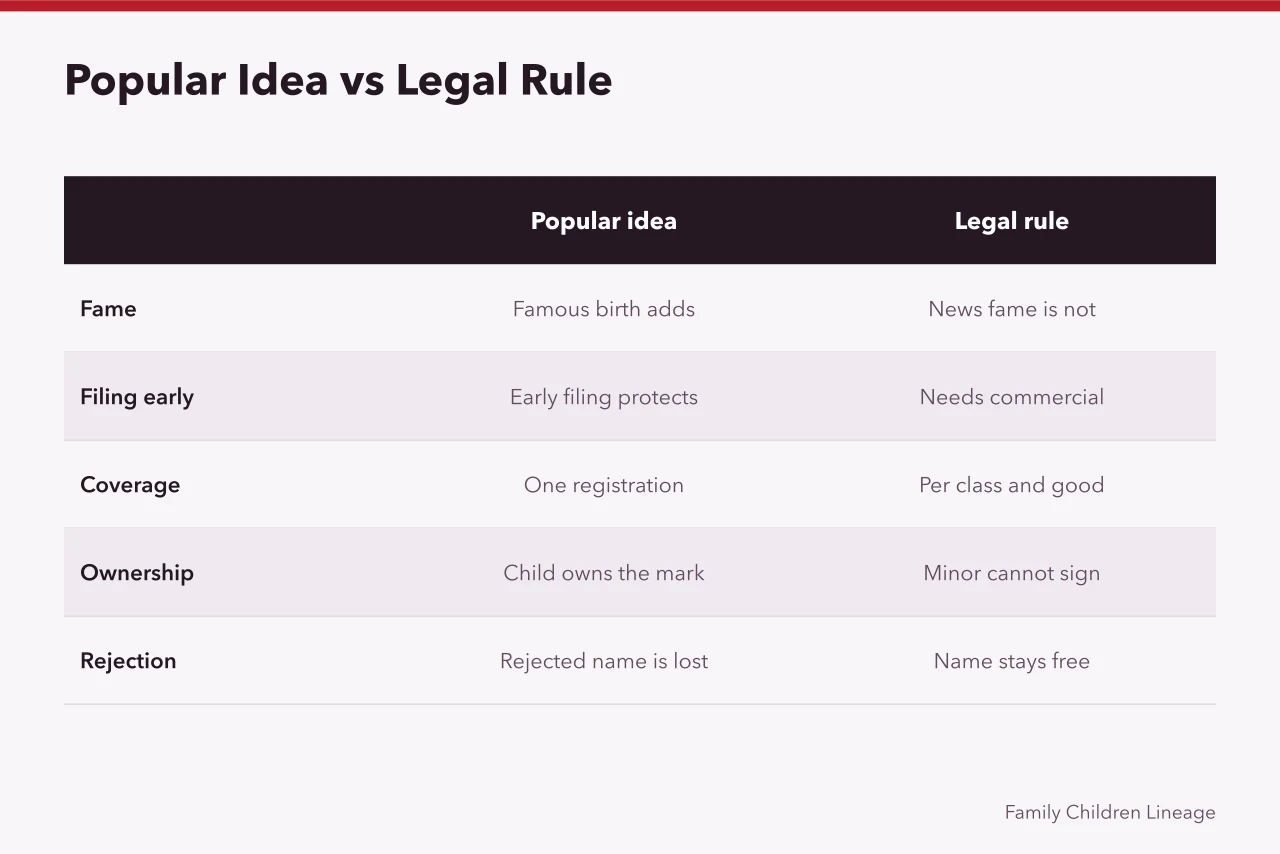
That last row matters most. A refusal is not a tragedy for the family. It is the system declining to hand one person a monopoly on a common word.
Three named filings and what they show
- Blue Ivy Carter.Since her birth, her parents have worked to secure trademarks of their daughter's name for everything, including books, shampoos and video games, and her mother, Beyoncé, argued during the trademark process that Blue Ivy is a "cultural icon". That is the product-tied route in the table above, pursued by parents who already run businesses.
- "Rise and shine."In October 2019 Kylie Jenner filed to trademark the phrase "rise and shine", a line that became a meme after footage of her singing it to her daughter Stormi went viral, and also "riiise and shiiinnee". The second filing would cover clothing, the first also cosmetics. The filing was for a phrase tied to goods, not for the child's name.
- "Kylie."A name filing can also lose to an older user of the same name. Jenner had filed a U.S. application for "Kylie" for advertising and endorsement services in 2015, and in February 2017 the Australian singer Kylie Minogue won the dispute over it.
Example: the clothing line that never shipped
A parent announces a birth and immediately files for the infant's first name in Class 25, though the application describes clothing, no clothing exists, and no launch is planned.
The examiner issues an office action asking for specimens and proof of use, but the parent cannot supply them.
The mark is abandoned, the fee is gone, and the name remains unregistered. This is the ordinary outcome, not an unusual one.
Records, privacy and the child
A trademark filing is a public record. The applicant's name, address, and goods description all become searchable. For a family that guards a child's privacy, that is a cost worth weighing before filing.
If you are mapping how public records accumulate around a birth, birth announcements and the details that decide it covers what gets published and by whom. Families thinking about the wider paper trail may also want family trees privacy before they attach a minor's full name to a commercial filing.
When a parent should not file
- The name is not used on any good or service yet.
- The only goal is to stop other people from using the name.
- The child is a minor and no business entity exists.
- The family wants the child's name kept out of searchable records.
If any box is checked, the filing is likely to fail or to create a record the family did not want. The comparison is not close: the USPTO rewards commercial use, and a baby name usually has none. For the naming side of the same story, 7 points on celebrity baby names that matter separates trend coverage from legal claims.